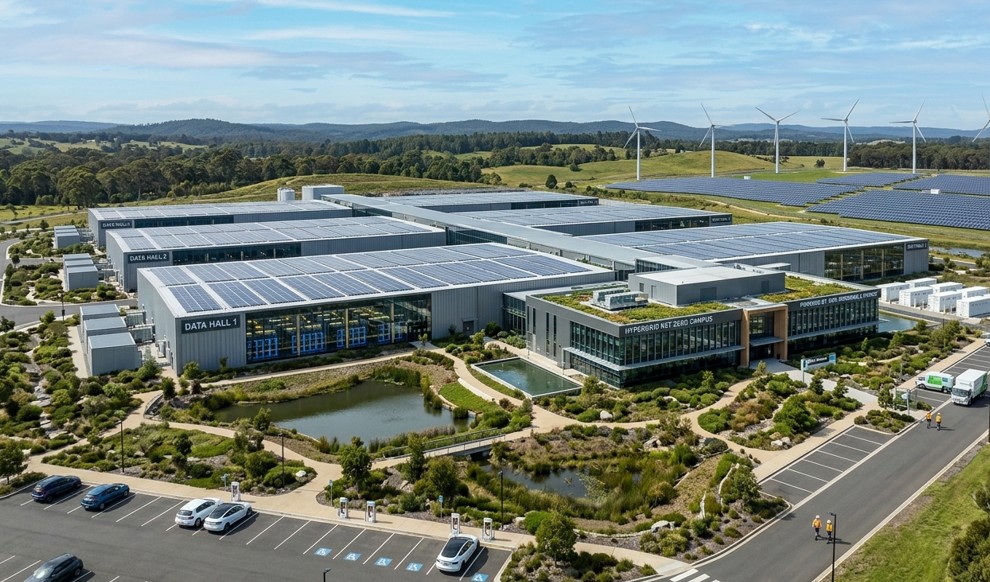


Data centers have become the critical infrastructure layer powering artificial intelligence, cloud computing, digital services, and industrial automation. However, the rapid expansion of computational demand is creating a new sustainability challenge: how to scale digital infrastructure while achieving net-zero emissions. The next generation of data centers will not be defined only by computing capacity but by their ability to operate with near-zero carbon intensity, optimized energy efficiency, and resilient low-carbon power systems.
Global data center electricity consumption reached approximately 415 TWh in 2024, representing around 1.5% of global electricity demand. This demand has been growing at approximately 12% annually since 2017, significantly faster than overall electricity consumption growth. The acceleration is primarily driven by artificial intelligence workloads, large language models, high-performance computing, and cloud expansion. The International Energy Agency (IEA) estimates that data center electricity consumption could continue rising substantially through 2030, making decarbonization of digital infrastructure a critical component of global climate strategies.
The challenge is not only the amount of electricity consumed, but the carbon intensity of that electricity. Data centers currently contribute approximately 180 million tonnes of CO₂ emissions annually from electricity use, with emissions projected to increase if grid decarbonization does not keep pace with demand growth. Under higher AI adoption scenarios, data center-related emissions could reach approximately 500 million tonnes by 2035. Achieving net zero therefore requires a transition from conventional grid dependence toward renewable energy integration, advanced efficiency technologies, and carbon-free power solutions.
Energy efficiency remains the first pillar of net-zero data center design. The industry measures efficiency through Power Usage Effectiveness (PUE), which represents total facility energy divided by IT equipment energy. The theoretical best-case PUE is 1.0, meaning all electricity directly powers computing equipment. However, the global industry average remains approximately 1.55-1.60, indicating significant energy consumption from cooling, power distribution, and auxiliary systems. Leading hyperscale facilities are achieving much lower PUE values through advanced cooling systems, optimized infrastructure design, and artificial intelligence-driven energy management.
Cooling is becoming one of the most critical engineering challenges as AI increases computing density. Traditional air cooling is becoming insufficient for next-generation AI clusters, where rack densities can exceed 50-100 kW per rack compared with conventional enterprise environments of approximately 5-15 kW per rack. Liquid cooling technologies, including direct-to-chip cooling and immersion cooling, are emerging as essential solutions to manage thermal loads while reducing energy consumption.
Renewable energy procurement is another core component of net-zero strategies. Technology companies are increasingly signing long-term renewable power purchase agreements (PPAs), developing behind-the-meter renewable assets, and exploring firm low-carbon power solutions. The IEA expects renewable energy to meet a significant share of incremental data center electricity demand growth through 2030, supported by expanding wind and solar deployment. However, intermittency remains a challenge, requiring integration with battery storage, grid flexibility, nuclear power, and other dispatchable low-carbon technologies.
Water efficiency is also becoming a critical sustainability metric. Conventional cooling systems can consume millions of litres of water annually for large facilities, particularly in water-stressed regions. Future net-zero data centers are increasingly adopting closed-loop cooling, liquid cooling systems, recycled water usage, and heat recovery solutions to minimize environmental impact.
The location strategy for data centers is changing fundamentally. Historically, facilities were built near major digital markets to reduce latency. However, energy availability is becoming equally important. Regions with abundant renewable resources, strong grids, available land, and supportive regulations are gaining competitive advantage. Countries in the Nordics, Middle East, North America, and Asia-Pacific are positioning themselves as future low-carbon digital infrastructure hubs.
By 2035, net-zero data centers will require an integrated approach combining renewable electricity, advanced cooling, AI-based energy optimization, efficient hardware, circular infrastructure design, and low-carbon supply chains.
Data centers are becoming the energy-intensive factories of the digital economy. The winners of the AI era will not only be those with the most advanced algorithms but those capable of building sustainable, resilient, and carbon-efficient computing infrastructure at global scale.